Paper Feed Pitch in Thermal Printing: What It Is and Why It Matters
When discussing thermal printer performance, most users focus on print speed, resolution, or supported paper width. However, one critical parameter is often overlooked: paper feed pitch. In real-world thermal printing, paper feed pitch plays a decisive role in print accuracy, barcode readability, and long-term stability—especially at high speeds.
This article explains what paper feed pitch is, what determines it in thermal printing systems, and why it matters more than many headline specifications.
What Is Paper Feed Pitch?
Paper feed pitch refers to the distance the paper advances for each incremental feed movement of a thermal printer.
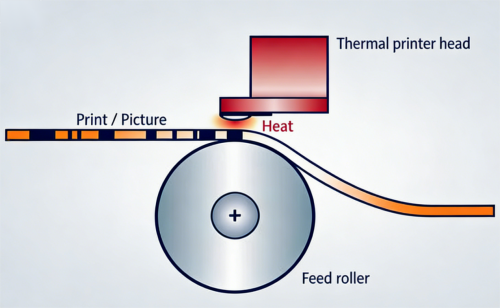
In practical terms, it defines how precisely a printer can control paper movement along the vertical (Y-axis) direction. Each feed step—driven by a motor and transmission system—moves the paper forward by a fixed, repeatable distance. That distance is the paper feed pitch.
Unlike print speed, which measures how fast paper moves over time, paper feed pitch measures how accurately the movement is controlled per step.
Why Paper Feed Pitch Matters in Thermal Printing
In thermal printing, print quality is determined not only by the thermal printhead but also by how accurately the paper moves underneath it.
Paper feed pitch directly affects:
• Vertical print accuracy (text spacing, line alignment)
• Barcode proportions, especially 1D barcode height consistency
• QR code and 2D code readability
• Image distortion at high printing speeds
Even a small deviation in paper feed pitch can cause vertical stretching or compression, leading to scanning failures or inconsistent output.
What Determines Paper Feed Pitch in a Thermal Printer?
Paper feed pitch is not defined by a single component. It is the result of mechanical design, motor control, and system-level coordination.
1.Mechanical Transmission and Roller Design
The mechanical feed system sets the physical foundation of paper movement.
Key factors include:
• Drive roller diameter
• Gear or belt transmission ratio
• Mechanical tolerances and rigidity
A larger roller diameter or different gear ratio directly changes how far the paper moves for each motor step.
2.Stepper Motor Step Angle and Drive Mode
Most thermal printers use stepper motors to control paper feeding.
Paper feed pitch depends on:
• Motor step angle (e.g., 1.8° per step)
• Drive mode (full-step, half-step, microstepping)
Microstepping allows finer paper movement resolution, improving feed accuracy—especially important for high-density labels and barcodes.
3.Controller Resolution and Firmware Logic
Even with precise mechanics, paper feed pitch accuracy depends on how well the controller manages motor signals.
Important factors include:
• Pulse frequency control
• Timing precision
• Firmware feed algorithms
A controller with limited resolution or poorly optimized firmware may reduce effective feed precision, regardless of mechanical capability.
4.Paper Resistance and Pressure System
Real printing conditions introduce variables that affect actual feed behavior:
• Paper thickness and stiffness
• Adhesive resistance on label stock
• Platen pressure consistency
At high speeds, insufficient pressure or uneven resistance can cause micro-slippage, resulting in feed pitch deviation.
Paper Feed Pitch vs Print Speed: Why Faster Is Not Always Better
Manufacturers often advertise high print speeds, but speed alone does not guarantee output quality.
As print speed increases:
• Feed control margins shrink
• Motor torque demands rise
• Thermal head heating time decreases
If paper feed pitch cannot be maintained accurately at high speed, the printer may:
• Automatically slow down
• Insert pauses
• Produce distorted output
This is why sustainable print speed is more meaningful than peak speed ratings.
How to Evaluate Paper Feed Pitch When Choosing a Thermal Printer
Paper feed pitch is rarely listed as a standalone specification, but it can be evaluated indirectly.
When selecting a thermal printer, consider:
• Consistency of barcode height at different speeds
• Print quality stability during long print runs
• Performance with dense graphics or 2D codes
• Manufacturer transparency about mechanism design
Testing real workloads often reveals more than headline specifications.
Final Thoughts: Paper Feed Pitch Is a System-Level Parameter
Paper feed pitch is a system-level parameter shaped by mechanical design, motor control, firmware logic, and real-world media interaction.
For users who care about print accuracy, barcode reliability, and long-term stability, understanding paper feed pitch provides deeper insight than print speed numbers alone. In thermal printing, precision is not about how fast the paper moves—but how accurately it moves every step of the way.