What Determines Thermal Printer Speed? Inside the Print Head, Motor, and Control System
Thermal printer speed is often listed as a simple number on a spec sheet—200 mm/s, 250 mm/s, or even faster. In real-world use, however, actual printing performance can vary significantly between devices with similar rated speeds. Some printers slow down during continuous jobs, while others maintain stable output without sacrificing print quality.
This is because thermal printer speed is not determined by a single component. It is the result of a tightly coupled system involving the thermal print head, motor, transmission structure, firmware, control electronics, and even the thermal paper itself. Understanding how these elements work together helps explain why real-world print speed often differs from advertised maximum values.
How Thermal Printing Works at High Speed
Thermal printers create images by heating tiny resistive elements on a thermal print head (TPH). When heat is applied, the coating on thermal paper reacts and turns dark. At higher speeds, this process must happen repeatedly in extremely short time intervals while maintaining uniform heat distribution and consistent paper movement.
The Role of Heat, Time, and Media
Every printed dot requires:
• Enough heat energy
• Sufficient activation time
• Consistent thermal paper response
At low speeds, these conditions are easy to satisfy. At high speeds, the margin for error becomes much smaller, making system design critical.
Thermal Print Head (TPH): The Core Limiting Factor for Print Speed
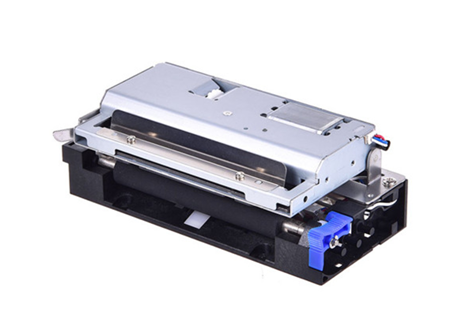
The thermal print head is the most important component affecting thermal printer speed.
Heating Efficiency and Dot Activation Speed
High-speed printing requires a print head that can:
• Heat up rapidly
• Reach target temperature uniformly
• Cool down quickly between print lines
Print heads with higher heating efficiency can activate dots faster, allowing shorter line intervals and higher sustained speeds.
Why Not All Print Heads Perform the Same
Differences in materials, resistor design, heat dissipation paths, and manufacturing quality mean that two printers with the same resolution may behave very differently at high speeds. In practice, print head performance often sets the upper boundary for usable print speed.
Motor Performance and Paper Feeding Speed
Even with a high-quality print head, paper must be fed accurately and consistently.
Stepper vs DC Motors in Thermal Printers
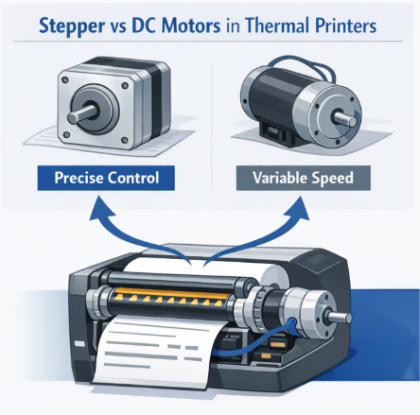
Most thermal printers use stepper motors because they offer precise control over paper movement. Motor speed alone is not enough—torque and control stability are equally important, especially during rapid acceleration and deceleration.
Why Motor Control Matters at High Speed
At higher speeds, insufficient torque or unstable motor control can cause:
• Inconsistent line spacing
• Paper slippage
• Print distortion
A well-matched motor and driver system ensures that paper movement remains synchronized with print head heating cycles.
Transmission System: The Often Overlooked Speed Bottleneck
The transmission system connects the motor to the paper path and plays a critical role in maintaining speed stability.
Gear Design, Roller Pressure, and Vibration Control
Key mechanical factors include:
• Gear ratio and backlash
• Roller pressure uniformity
• Structural rigidity
Poor transmission design can introduce vibration or micro-slippage that limits usable print speed, even if the motor and print head are capable of more.
Mechanical Stability and Usable Speed
In many cases, mechanical instability—not electronics—forces printers to slow down to maintain acceptable print quality.
Does Thermal Paper Affect Printing Speed? Yes—Here’s Why
Thermal paper is not just a consumable; it is an active part of the printing process.
Paper Sensitivity and Heating Time
High-sensitivity thermal paper requires less heat to achieve the same image density. This allows printers to operate at higher speeds without increasing print head temperature excessively.
Consistency Matters at High Speed
Inconsistent paper coatings can lead to uneven darkness or missing dots during fast printing. For high-speed applications, consistent paper quality is essential to maintain clarity and contrast.
Firmware and Control Board (MCU): Turning Hardware Potential into Real Speed
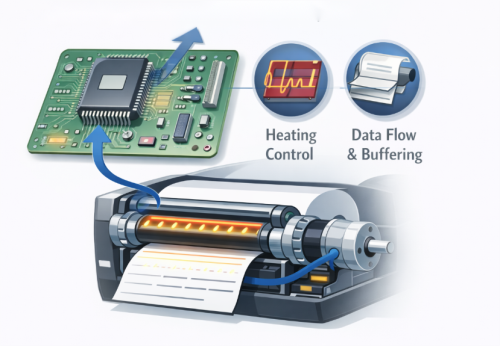
Hardware alone does not determine print speed. Firmware and control electronics decide how efficiently that hardware is used.
Firmware Control of Heating and Data Flow
Printer firmware manages:
• Heating pulse timing
• Line buffering
• Energy distribution across the print head
Optimized control algorithms allow the print head to operate closer to its physical limits without overheating.
MCU Performance and Sustained Speed
A capable MCU ensures that data processing, buffering, and motor control remain synchronized. Insufficient processing power or memory can cause slowdowns during continuous or complex print jobs.
Why Maximum Speed Specs Don’t Tell the Whole Story
Maximum speed ratings typically reflect short-duration peak performance under ideal conditions.
Peak Speed vs Continuous Stable Speed
In real-world use, printers must maintain speed over long print runs without overheating, misfeeding, or degrading print quality. Continuous stable speed is often more important than peak speed.
Why Thermal Printers Slow Down in Practice
Common reasons include:
• Thermal buildup in the print head
• Motor or transmission instability
• Firmware-imposed protection limits
• Low-quality or inconsistent paper
Understanding these constraints helps explain why two printers with similar specifications may perform very differently.
Key Takeaways: What Really Determines Thermal Printer Speed
Thermal printer speed is the result of system-level design, not a single specification. The most important factors include:
• Thermal print head heating efficiency
• Motor torque and control stability
• Transmission system rigidity and precision
• Thermal paper sensitivity and consistency
• Firmware algorithms and MCU performance
Evaluating these elements together provides a more accurate picture of real-world printing performance than speed ratings alone.
Frequently Asked Questions
Q1: What determines thermal printer speed the most?
Thermal print head heating efficiency and system stability are the most critical factors. Other components support or limit how close a printer can operate to its theoretical speed.
Q2: Why do thermal printers slow down during continuous printing?
Thermal buildup, firmware protection mechanisms, mechanical limitations, or paper quality issues can all cause speed reduction during long print runs.
Q3: Does faster printing always reduce print quality?
Not necessarily. Well-designed printers can maintain print quality at high speeds, but this depends on print head performance, paper quality, and control algorithms.