Tool-Free Printhead and Platen Roller Replacement: A Timeline for Thermal Printer Mechanisms
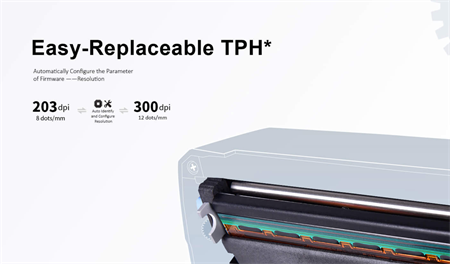
In thermal and thermal-transfer printers, the two most wear-prone components are the thermal printhead (TPH) and the platen roller. When either fails, production lines stop.
Historically, replacing them required removing covers, loosening screws, and often waiting for a technician. Over the past decade, the industry has moved toward tool-free, quick-change designs that allow operators to swap these parts in minutes—sometimes seconds—without special tools.
This article provides an objective timeline of that evolution, explains what “tool-free” actually means in 2026, and outlines how to evaluate manufacturer claims when selecting a thermal printer mechanism.
2010s (Mid–Late): From “Remove Screws” to “Release Latches”
Early desktop and mid-range thermal printers typically required multiple screws or partial disassembly to access the printhead carriage and platen bearings.
By the mid-2010s, service manuals began documenting latch-based release mechanisms for the printhead assembly and tab-style bearings for the platen roller.
Operators could open the top cover, release latches, and slide out the printhead bracket. Platen rollers could be removed by disengaging side tabs and rotating the roller free.
Impact: Fewer tools, shorter access paths, and clearer procedures. Replacement still required care (power off, cool-down, media and ribbon removal), but downtime began dropping from hours to tens of minutes in many cases.
2020–2023: Industrial Printers Standardize Field-Replaceable Parts
As industrial barcode and label printers scaled in warehouses and production lines, manufacturers placed greater emphasis on field-replaceable printheads and quick platen roller swaps that required no special tools.
Product documentation highlighted snap-in carriages, lever-actuated latches, and bearing clips that trained operators could handle independently. Messaging focused on reduced downtime and lower total cost of ownership (TCO) by minimizing technician visits for routine maintenance.
Impact: Maintenance became part of normal shift routines. Teams could keep spare printheads and rollers on site and perform swaps during planned stops, helping maintain stable throughput.
2024–2026: Tool-Free Becomes a Headline Feature
In the latest generation of desktop and industrial print modules, tool-free replacement is frequently positioned as a core benefit. Common design elements include:
✔️ Magnetic or spring-loaded latches that secure the printhead carriage and release with a single motion
✔️ Quick-change carriages that slide out once latches are opened, reducing cable handling
✔️ Platen rollers with clip-on bearings or drop-in shafts that can be removed by hand after opening the media path
✔️ Wider head-open angles (often around 60°) that improve access to sensors, the media path, and the platen surface
Some vendors now claim replacement times measured in minutes for both the printhead and platen roller. A few desktop models promote seconds-level printhead swaps as a differentiator.
Impact: In high-mix, high-uptime environments such as fulfillment centers, manufacturing lines, and retail back offices, faster swaps translate into higher equipment availability and more predictable consumable costs.
What “Tool-Free” Really Means in Practice
“Tool-free” does not mean “no procedure.” A realistic operator workflow still includes these steps:
1. Power off the printer and allow the printhead to cool to avoid burns and protect the heating elements.
2. Open the media path and remove label stock and ribbon (for thermal-transfer models).
3. Release the latches, then slide out the printhead carriage or unclip the platen roller.
4. Install the new component, ensuring correct orientation and full seating.
5. Close the mechanism, reload media and ribbon, and run a calibration or test print to verify darkness, alignment, and sensor performance.
Even with quick-change hardware, total time typically ranges from 2 to 10 minutes, depending on the design of the print module, available workspace, and whether the team follows a preventive maintenance schedule.
How to Evaluate a Print Module's Quick-Swap Claims
When comparing thermal printer mechanisms, treat “tool-free” as a measurable service feature rather than marketing language. Request the following details:
· Step count and tool list — How many latches, levers, or fasteners must be operated? Are any tools required, even a small hex key?
· Access geometry — What is the head-open angle? Can an operator reach the printhead and platen without removing additional components?
· Spare-part strategy — Are the thermal printhead and platen roller stocked as standard spares? What are the part numbers and typical lead times?
· Calibration requirements — Does the printer auto-calibrate after a swap, or is a manual routine required?
· Real-world time studies — Ask for a timed demonstration (video or on-site) of a complete printhead and platen roller replacement under normal operating conditions.
These concrete metrics matter far more than generic claims such as “seconds-level replacement,” which can vary significantly based on operator training and site workflow.
Bottom Line for Specifiers and Integrators
The shift toward tool-free printhead and platen roller replacement is genuine. Designs have progressed from mid-2010s latch mechanisms to the 2025–2026 generation of quick-swap modules found across both desktop and industrial thermal printer mechanisms.
The operational benefit is measurable: faster swaps reduce unplanned downtime, stabilize throughput, and make consumable costs more predictable.
However, marketing claims require context. Seconds-level or one-handed swaps are achievable on certain models under ideal conditions, but most real-world replacements still take several minutes once cool-down, media handling, and calibration are included.
For anyone evaluating a thermal printer mechanism, this timeline offers a clear, evidence-based framework for assessing maintenance friendliness—and for pushing vendors to provide concrete, testable service metrics rather than vague slogans.