What Is LPN in Logistics? License Plate Numbers Explained for Warehouses
In logistics, LPN means License Plate Number. It is a unique identifier assigned to a pallet, carton, tote, container, or another logistics unit so a warehouse management system can track the unit and its contents.
The term "license plate" does not refer to a vehicle registration plate. In a warehouse, it works more like a digital identity for physical inventory. A barcode or RFID tag carries the LPN, while the WMS stores the related product, quantity, location, batch, and shipping data.
How Does LPN Work in a Warehouse?
An LPN connects a physical logistics unit to its digital record. When a warehouse receives a pallet, the WMS may create a new LPN or capture one supplied through an advance shipping notice (ASN).
The LPN can then follow the unit through several warehouse activities:
• Receiving and inspection.
• Put-away and location assignment.
• Internal transfers.
• Cycle counting.
• Picking, packing, and repacking.
• Shipping and carrier handoff.
• Returns processing.
Consider a pallet containing 40 cartons. Without license plating, an operator may need to scan each carton during a warehouse transfer. With an LPN, the operator scans the pallet label once, and the WMS moves the complete inventory record to the new location.
The same principle applies to a carton, tote, or roll cage. The LPN may represent the physical container and its contents, or a logical group of inventory managed as one unit. Oracle Warehouse Management, for example, uses LPNs to associate inventory with containers and track material through warehouse transactions.
This is why LPN in logistics matters: it reduces repetitive data entry and gives warehouse teams a practical way to control inventory at the handling-unit level.
What Is a License Plate Label and How Is It Used?
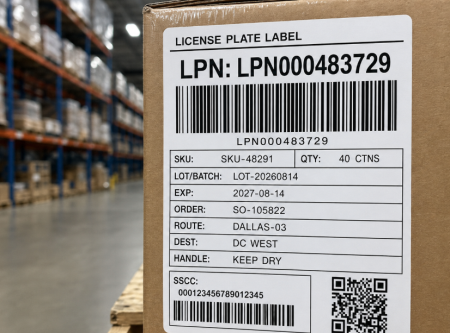
A license plate label is the physical label that carries an LPN. It normally includes a human-readable number and a machine-readable barcode. Some operations also use RFID to identify the same logistics unit without requiring line-of-sight scanning.
A typical LPN label may contain:
• LPN or handling-unit number.
• Code 128, GS1-128, or QR Code.
• SKU and quantity.
• Lot or batch number.
• Expiration date.
• Order, route, or destination reference.
• Handling instructions.
• SSCC, where GS1 logistics identification is required.
The label may be attached to a carton, pallet, tote, cage, or other container. In e-commerce fulfillment, an LPN label can identify a carton moving between picking, packing, sortation, and dispatch. In manufacturing, it can identify work-in-process material. In healthcare logistics, it may support the movement of case supplies, sterile products, or replenishment containers.
The distinction is simple:
• LPN: The unique number recorded in the WMS.
• License plate label: The physical label displaying that number.
• Barcode or RFID: The data carrier used by scanners or readers.
For a pallet, the label should remain visible and scannable throughout storage and transport. Its position, orientation, size, and barcode quality should follow the requirements of the warehouse, trading partner, and applicable labeling standard.
How Are LPN Labels Printed and Applied?
LPN labels are typically generated from a WMS, ERP, or shipping application and sent to a thermal barcode printer.
In manual or semi-automated warehouses, operators use direct thermal or thermal transfer printers to produce labels for cartons, pallets, totes, and other handling units. Direct thermal printing is suitable for many short-term shipping applications, while thermal transfer is a better choice when labels need greater resistance to abrasion, chemicals, heat, or long-term storage.
In high-volume warehouses, print-and-apply systems automate the process. For cartons, the equipment is usually installed beside a conveyor: the system identifies the carton, generates the correct LPN label, prints it, and applies it to a designated panel.
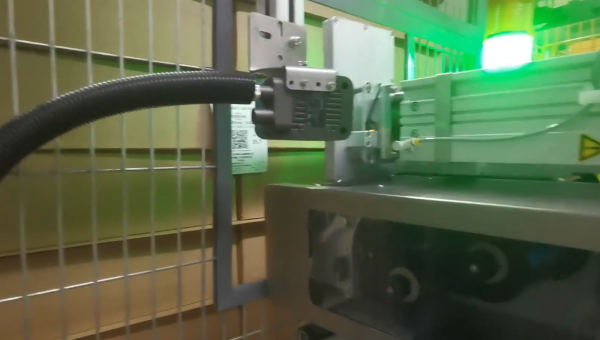
For pallets, automatic pallet labelers can be integrated with pallet conveyors, stretch wrappers, robotic palletizing cells, or dispatch lines. These systems reduce manual handling and help prevent missing, incorrectly positioned, or unreadable labels. Industrial print engines and applicators are commonly designed for cartons, cases, and pallets in manufacturing and warehouse environments.
Is LPN the Same as SSCC?
No. LPN and SSCC can serve similar operational purposes, but they are not automatically the same identifier.
Identifier | Main purpose |
LPN | Identifies a pallet, carton, tote, or inventory group within a WMS or company network. |
SSCC | Globally identifies a logistics unit under the GS1 system. |
SKU or GTIN | Identifies a product type or trade item. |
Serial number | Identifies one individual product. |
An LPN is primarily a warehouse and inventory-control concept. A company may generate LPNs using its own numbering rules, and those numbers may only have meaning inside its WMS.
An SSCC, by contrast, is a GS1 Identification Key for a logistics unit. GS1 defines a logistics unit as any composition of goods assembled for storage or transport, including cartons, cases, and pallets. The SSCC remains associated with that unit for its operational life and provides a globally unique reference.
Some businesses use an SSCC as their LPN, especially when they need standardized communication with retailers, carriers, manufacturers, or international trading partners. Others maintain an internal LPN and generate an SSCC for external logistics labels.
Before implementing license plate labels, confirm which identifier the WMS, ERP, customers, and trading partners expect. Then select the barcode symbology, label material, printer, and application method around that requirement.