How Thermal Printer Mechanisms Are Integrated into Medical Devices

Modern medical equipment generates large amounts of diagnostic data. Doctors and technicians often need printed charts, reports, or labels immediately after a test. For this reason, many manufacturers integrate thermal printer mechanisms directly into medical devices.
Thermal printing provides fast, reliable, and maintenance-free output without ink or toner. The technology is widely used in ECG machines, patient monitoring systems, laboratory analyzers, and hospital labeling equipment.
This article explains why medical devices rely on thermal printer mechanisms, how they are integrated into equipment, and how the technology is evolving in healthcare systems.
Why Medical Devices Use Thermal Printer Mechanisms
Healthcare environments demand speed, reliability, and simple operation. Thermal printing meets these requirements better than many traditional printing technologies.
Several factors explain why medical device manufacturers choose embedded thermal printing.
Ink-Free Operation
Thermal printers create images by heating special paper or ribbon. They do not require ink cartridges or toner.
This design reduces maintenance and eliminates the risk of ink leakage or drying, which is important for devices used in clinical environments.
Fast Printing for Real-Time Results
Many medical tests produce results that clinicians must review immediately.
Thermal printers can quickly generate:
• diagnostic charts
• monitoring reports
• patient records
Fast output allows healthcare professionals to make decisions without waiting for external printing systems.
Compact Size for Embedded Devices
Medical equipment often needs to remain compact and portable. Thermal printer mechanisms are designed as small modular units that fit inside diagnostic devices.
This makes them suitable for:
• portable ECG systems
• handheld diagnostic instruments
• bedside monitoring equipment
High Reliability in Clinical Environments
Medical equipment must operate continuously with minimal downtime.
Thermal printers contain fewer moving parts than many other printer types. This simple mechanical design improves reliability and reduces failure rates.
For devices used in hospitals or laboratories, reliability is a critical requirement.
Common Medical Devices That Use Thermal Printer Mechanisms
Thermal printer mechanisms appear in many healthcare devices. These systems rely on printed output to record measurements, identify samples, or label patients.
ECG Machines
Electrocardiogram machines measure the electrical activity of the heart.
Integrated thermal printers produce:
• heart rhythm graphs
• diagnostic reports
• patient examination results
Thermal printing is ideal for ECG devices because it can reproduce high-resolution waveform charts at high speed.
Patient Monitoring Systems
Patient monitors track vital signs such as heart rate, oxygen saturation, and blood pressure.
Thermal printers allow these systems to print:
• monitoring reports
• alarm events
• patient data summaries
This helps medical staff document changes in patient condition.
Laboratory Analyzers
Clinical laboratories process many samples each day. Many analyzers include built-in thermal printers that produce:
• sample identification labels
• barcode tracking labels
• printed test results
These printed outputs help laboratories maintain accurate records and trace samples through the testing process.
Hospital Labeling Systems
Thermal printing also supports hospital identification systems.
Hospitals commonly use thermal printers for:
✔️ patient wristbands
✔️ medication labels
✔️ specimen labels
✔️ pharmacy packaging
Clear printed barcodes and text help reduce identification errors and improve patient safety.
How Thermal Printer Mechanisms Are Integrated into Medical Equipment
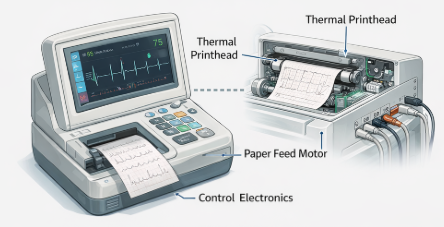
Medical device manufacturers embed thermal printers as internal printing modules that connect directly to the device’s control system.
Several components work together to enable this integration.
Compact Printer Module Design
Thermal printer mechanisms are usually delivered as modular assemblies that include:
• thermal printhead
• platen roller
• paper feed motor
• control circuitry
The module installs inside the medical device housing and connects to the main system board.
Because these modules are compact and lightweight, engineers can integrate them without significantly increasing device size.
Data Communication Interfaces
The medical device sends print data to the printer mechanism through electronic communication interfaces.
Common interfaces include:
• UART
• USB
• RS-232
• SPI
The device software formats diagnostic data before sending it to the printer.
For example, an ECG system converts electrical signals into graphical waveform data that the printer can reproduce on paper.
Thermal Printhead Operation
The thermal printhead is the key component responsible for producing the printed image.
The printhead contains a row of tiny heating elements. When activated, these elements heat specific areas of the paper.
Two main printing methods are used:
Direct thermal printing, where heat activates special paper
Thermal transfer printing, where heat transfers ink from a ribbon onto labels
Both methods create clear text, graphics, or barcodes without using traditional ink cartridges.
Embedded Software Control
Software inside the medical device controls the printing process.
The system manages tasks such as:
✔️ formatting medical data
✔️ generating printable reports
✔️ controlling paper movement
✔️ monitoring printer status
This software integration ensures that printed output accurately represents the device’s diagnostic data.
Design Considerations for Embedded Thermal Printing
When engineers integrate a thermal printer mechanism into medical equipment, they must consider several technical factors.
Space Constraints
Medical devices often have limited internal space. Printer mechanisms must be compact enough to fit inside the device housing without affecting other components.
Manufacturers typically select low-profile printer modules designed specifically for embedded systems.
Power Consumption
Portable medical devices rely on battery power. Engineers must ensure that the printer does not consume excessive energy.
Efficient thermal printheads and optimized printing cycles help reduce power usage.
Paper Handling and Media Selection
Medical applications may require specific types of media, such as:
✔️ durable thermal paper
✔️ medical-grade label materials
✔️ wristband media for patient identification
Proper paper handling mechanisms are essential to ensure reliable printing.
Data Reliability and Compliance
Healthcare devices must meet strict regulatory requirements. Printed records must remain readable for the required documentation period.
Manufacturers often select high-quality thermal media and reliable printer mechanisms to meet these standards.
Emerging Innovations in Medical Thermal Printing
Thermal printing technology continues to evolve as healthcare equipment becomes more advanced.
Several trends are shaping the future of embedded printing.
Portable Diagnostic Equipment
Portable medical devices are becoming more common in clinics and emergency services.
Examples include:
• handheld ECG units
• portable ultrasound systems
• mobile monitoring devices
Embedded thermal printers allow these devices to produce immediate printed reports in the field.
Smart Hospital Identification Systems
Hospitals increasingly rely on automated identification systems.
Thermal printing supports:
• barcode patient wristbands
• medication tracking labels
• laboratory sample labels
These systems improve workflow efficiency and reduce medical errors.
Connected Healthcare Devices
Many modern medical devices connect to hospital networks or cloud platforms.
Some systems now combine:
• digital data storage
• wireless communication
• integrated thermal printing
This allows clinicians to maintain digital records while still producing printed documentation when necessary.
Challenges of Thermal Printing in Medical Applications
Despite its advantages, thermal printing also presents certain limitations.
Print durability
Direct thermal prints can fade over time when exposed to heat, light, or chemicals.
Media sensitivity
Thermal paper reacts to temperature and friction. Hospitals must store paper properly to avoid damage.
Regulatory requirements
Medical equipment must comply with safety and quality standards. Embedded printers must meet these regulatory guidelines.
Manufacturers address these challenges by selecting high-quality thermal materials and durable printer mechanisms.
The Future of Embedded Thermal Printer Mechanisms in Healthcare
Thermal printing remains an important technology in medical equipment design.
Future developments will likely focus on:
smaller and more efficient printer mechanisms
improved print durability
better integration with portable medical devices
advanced labeling systems for patient identification
As healthcare systems continue to adopt smarter and more connected technologies, embedded thermal printer mechanisms will remain essential for reliable, on-site medical documentation.