Eco-Barcode Printers: Sustainable Printing with Green Innovations in 2026
As regulatory pressures mount and consumers demand transparency, businesses face a stark choice: adapt printing processes to minimize environmental impact or risk falling behind competitors.
In 2026, eco-friendly barcode printers emerge as a practical solution, leveraging recyclable labels and green inks to cut waste and energy use. These technologies directly address supply chain sustainability goals, enabling industries like fashion and food to meet ESG standards without sacrificing efficiency.
Green Materials Driving Barcode Sustainability
Recyclable labels form the foundation of sustainable barcode printing. Manufacturers produce these from post-consumer waste paper, incorporating 15-30% recycled content while maintaining scannability.
For instance, fiber-based alternatives derived from sugarcane bagasse or cotton waste resist water and oils, outperforming traditional plastic liners in humid environments. This durability stems from their natural composition, which bonds tightly during thermal transfer without synthetic adhesives.
Linerless labels take this further by eliminating disposable backing paper, which accounts for up to 40% of label waste in high-volume operations. The adhesive coats the label's back directly, allowing continuous printing from a single roll.
In practice, this reduces roll changes by half, lowering downtime in fast-paced settings. Fashion brands, which cycle through thousands of SKUs seasonally, benefit most: a single production run generates fewer scraps, aligning output with just-in-time inventory needs.
Eco-Friendly Inks and Printer Technologies
Green inks replace petroleum-based formulas with plant-derived options like soy or linseed oils. These water-based alternatives emit 70% fewer volatile organic compounds (VOCs), improving workplace air quality while ensuring barcode contrast ratios exceed 7:1 for reliable scanning. Thermal printers apply heat to transfer these inks precisely, avoiding solvent evaporation that plagues traditional methods.
Energy-efficient printers amplify these gains. ENERGY STAR certified models like the HPRT series consume 20-30% less power during idle and print cycles through advanced sleep modes and precise heater controls.
IoT connectivity allows remote monitoring, predicting ribbon depletion to prevent overprinting. In food packaging, where labels must withstand refrigeration, BPA-free thermal ribbons ensure compliance with emerging regulations like the EU's Packaging and Packaging Waste Directive, effective 2026.
Applications in Fashion and Food Industries
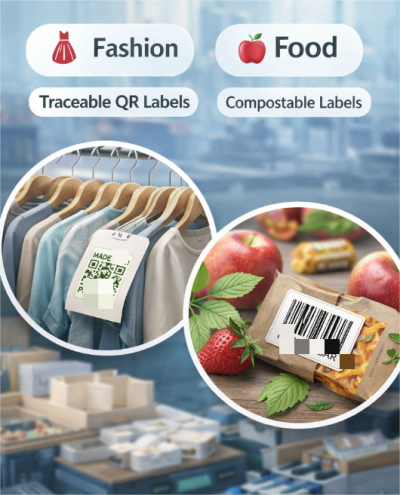
Fashion supply chains demand agile labeling for global traceability. Recyclable labels track garments from mill to store, embedding QR codes that link to origin data. A mid-sized apparel firm reduced plastic waste by 35% after switching to sugarcane-based tags, as the material biodegrades in industrial composters within 90 days. This shift not only cuts landfill contributions but also appeals to eco-conscious buyers scanning codes for authenticity.
Food producers face stricter challenges with perishable goods. Biodegradable thermal labels adhere to wet surfaces like fruit packaging, displaying batch codes and expiration dates. Unlike vinyl alternatives, these dissolve harmlessly, supporting zero-waste goals. Consider a protein bar manufacturer: green ink printing on compostable stock extends shelf visibility while meeting USDA composting standards, reducing disposal costs by 25%.
Industry | Key Application | Sustainability Benefit | Efficiency Gain |
Fashion | Supply chain QR tags | 40% plastic reduction | 50% fewer roll changes |
Food | Perishable goods labels | Biodegradable in 90 days | 35% waste cut, scan reliability >99% |
Implementation Steps and ROI Considerations
Businesses transition methodically. First, audit current label volume and waste metrics to baseline improvements. Select printers with modular heads for easy upgrades to green ribbons. Test compatibility in pilot runs, focusing on scan rates under real conditions like condensation or UV exposure.
Initial costs rise 10-15% due to premium materials, but ROI materializes within 6-12 months. Energy savings alone recoup 20% of outlay, while waste diversion lowers disposal fees. For a Denver-based food processor handling 10,000 labels daily, this translates to $15,000 annual savings, factoring local recycling incentives. Long-term, these systems future-proof operations against 2027 GS1 standards mandating digital product passports.
Key Takeaways
Eco-friendly barcode printers deliver measurable environmental and operational wins through recyclable materials and green inks. Fashion and food sectors gain the most from waste reduction and regulatory alignment. Companies prioritizing these technologies position themselves for sustained compliance and cost efficiency in 2026.
FAQ
Q1: What materials make eco-friendly barcode labels sustainable?
Sugarcane bagasse, cotton waste, and post-consumer recycled paper form the base, often paired with water-based adhesives for linerless designs that cut waste by 40%.
Q2: How do green inks improve barcode printing?
Plant-based inks like soy reduce VOC emissions by 70% and maintain high contrast for scanning, applied via thermal transfer without solvents.
Q3: Which industries benefit most from sustainable barcode printers?
Fashion uses them for traceable QR tags; food applies them to perishable packaging for biodegradable, regulation-compliant labeling.
Q4: What is the ROI timeline for switching to eco barcode printers?
Most firms recover costs in 6-12 months through energy savings (20-30%) and reduced waste disposal.