How AI Is Transforming Barcode Printing: From Error Correction to Predictive Maintenance
Barcode printing has long been treated as a simple output task. In reality, it sits at the core of modern supply chains. A poorly printed barcode can disrupt scanning, delay shipments, and increase operational costs.
Today, artificial intelligence (AI) is changing that role. It is turning barcode printing from a static process into an adaptive, intelligent system that improves accuracy, reduces errors, and supports automation at scale.
Why Traditional Barcode Printing Falls Short
Traditional barcode printers rely on fixed settings and manual calibration. Operators adjust print density, speed, and alignment based on experience. This approach creates several problems:
· Inconsistent print quality across batches
· Barcode distortion due to heat or material variation
· Limited ability to detect or correct errors in real time
· Reactive maintenance after failures occur
In high-volume environments such as warehouses or production lines, even small errors can lead to scanning failures and costly reprints.
How AI Improves Barcode Printing
AI introduces real-time analysis and decision-making into the printing process. Instead of relying on static parameters, the system continuously adjusts based on data.
1. Print Quality Optimization
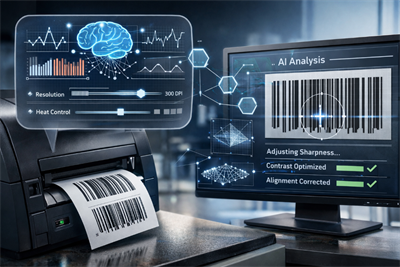
AI algorithms monitor barcode output during printing. They analyze contrast, edge sharpness, and line consistency, then automatically adjust settings such as heat intensity and print speed.
This ensures that each barcode meets scanning standards, even when materials or environmental conditions change.
2. Barcode Error Detection and Reconstruction
Damaged or incomplete barcodes are a common issue in logistics and manufacturing. AI can detect missing or distorted elements and reconstruct the barcode structure based on encoding rules.
For example, computer vision models can identify gaps in a QR code or misaligned bars in a 1D code. The system then corrects the output before or during printing, improving scan success rates.
3. Predictive Maintenance
AI can also monitor printer health. By analyzing patterns such as print head wear, line breaks, or temperature fluctuations, it predicts when components are likely to fail.
This allows operators to schedule maintenance before breakdowns occur, reducing downtime and extending equipment lifespan.
Real-World Applications of AI-Driven Barcode Printing
AI-powered barcode printing is already emerging in several high-value scenarios.
Smart Warehousing and Logistics
Automated warehouses rely on accurate labeling for sorting and tracking. AI improves barcode clarity and reduces misreads, enabling faster scanning by robots and handheld devices.
Drone-Based Inventory Management
In large storage facilities, drones are increasingly used to scan barcodes at height. AI-enhanced printing ensures that codes remain readable under varying angles, lighting conditions, and distances.
Manufacturing and Traceability
In production environments, barcode labels support product tracking and compliance. AI helps maintain consistent print quality across high-speed lines, ensuring reliable traceability.
AI vs. Traditional Barcode Printing
Traditional Printing | AI-Driven Printing |
Fixed settings | Adaptive optimization |
Manual calibration | Automatic adjustment |
Reactive maintenance | Predictive maintenance |
Error detection after printing | Real-time correction |
This shift reduces waste, improves efficiency, and supports automation.
Challenges to Consider
Despite its advantages, AI-driven barcode printing still faces practical challenges:
· Data requirements for training accurate models
· Integration with existing printer hardware and systems
· Cost considerations for small and mid-sized operations
However, as AI becomes more accessible, these barriers are gradually decreasing.
The Future of Barcode Printing
AI is pushing barcode printers toward becoming intelligent devices rather than simple output tools. Future systems will likely:
· Self-adjust based on usage patterns
· Integrate with IoT and edge computing systems
· Continuously learn from scanning feedback
In this model, printing becomes part of a closed-loop system where output, scanning, and analysis are fully connected.
Bottom Line
AI is redefining barcode printing by making it more accurate, reliable, and efficient. It reduces errors before they occur, predicts maintenance needs, and supports increasingly automated operations.
As supply chains become more complex, intelligent barcode printing will play a critical role in ensuring smooth and scalable workflows.
FAQ
What is AI-driven barcode printing?
AI-driven barcode printing uses machine learning and computer vision to optimize print quality, detect errors, and automate maintenance.
Can AI fix damaged barcodes?
Yes. AI can identify missing or distorted elements and reconstruct barcode structures to improve readability.
How does AI improve barcode print quality?
AI analyzes print output in real time and adjusts parameters such as heat and speed to maintain consistent quality.
What is predictive maintenance in barcode printers?
It uses data analysis to predict component wear and prevent failures before they occur.