How Firmware Affects Thermal Printing Performance
Thermal printing performance is often evaluated in terms of printhead quality, resolution, or mechanical design. While these factors are important, they do not fully explain real-world performance.
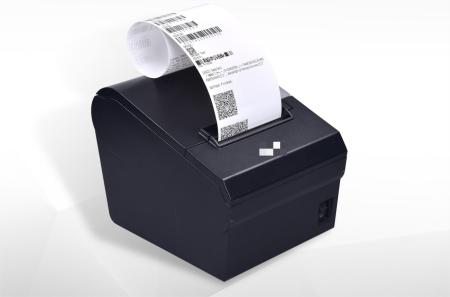
In practice, thermal printer firmware plays a critical role in controlling how hardware capabilities are used, especially in barcode and label printing applications.
Key Takeaways
• Firmware controls heating timing, buffering, and protection logic
• Print performance depends on both firmware and hardware constraints
• Many printing issues are multi-factor, not firmware-only
Core insight:
Firmware defines how hardware capabilities are used — but it cannot exceed physical limits.
Thermal Printing System Overview
A typical thermal printing workflow:
Host → Driver → Firmware → Controller → Printhead
Firmware acts as the real-time execution layer, translating incoming data into precise heating actions and timing control.
Heat Control and Print Quality
Thermal printing relies on controlled heat pulses applied to each dot.
Firmware determines:
• Pulse duration (heating time)
• Energy distribution
• Activation timing
These parameters directly influence:
• print darkness
• contrast
• edge sharpness
In practice, print density is jointly determined by hardware capability and firmware configuration.
Print Speed vs Output Stability
Print speed is not purely a mechanical parameter.
At higher speeds:
• Less time is available for heating
• Thermal recovery becomes limited
• Output consistency may degrade
Firmware helps manage this trade-off by:
• adjusting timing parameters
• controlling line processing
• regulating data flow
High-speed thermal printing is a system-level coordination problem, not a single-component issue.
Thermal Management and Protection
Thermal printheads accumulate heat during continuous operation.
Firmware typically:
• monitors temperature
• limits duty cycles
• adjusts performance dynamically
These mechanisms help:
• prevent overheating
• reduce printhead wear
• maintain stable output
However, thermal stability also depends on:
• printhead design
• cooling conditions
• media characteristics
Data Flow and Buffer Management
Firmware manages how data is processed before reaching the printhead.
Key elements include:
• line buffers
• input queues
• communication control
Poor data handling may lead to:
• skipped lines
• misalignment
• incomplete prints
Many apparent “printing errors” are related to data timing or buffering behavior, not only hardware faults.
Printhead Driving Strategies
Different firmware implementations use different driving methods:
• full-line activation
• segmented heating
• energy balancing
These strategies aim to:
• reduce peak current
• maintain uniform density
• stabilize output across the page
The effectiveness of these algorithms directly affects print consistency and barcode quality.
Barcode Readability and Firmware
In barcode and label printing, firmware plays a significant role in scan performance.
Key influencing factors:
• edge definition
• contrast consistency
• dot alignment
However, barcode readability is also influenced by:
• printhead resolution
• label material
• environmental conditions
Reliable scanning is the result of system-level optimization, not firmware alone.
Troubleshooting Perspective
When diagnosing thermal printing issues, firmware should be evaluated alongside hardware and materials.
Symptom | Possible Causes |
Faded output | low heating energy, media mismatch, power instability |
Uneven density | timing imbalance, printhead wear, pressure variation |
White lines | damaged elements, contamination, protection behavior |
Skipped lines | buffer issues, communication timing errors |
Effective troubleshooting requires a multi-factor approach rather than single-cause assumptions.
Firmware vs Hardware: Performance Impact
Factor | Firmware Influence | Hardware Influence |
Print density | timing, energy control | printhead capability |
Print speed | scheduling, buffering | motor and mechanics |
Stability | thermal protection logic | cooling and structure |
Barcode quality | alignment, edge control | resolution and head quality |
Practical Conclusion
Firmware has a significant influence on thermal printing performance because it coordinates heat control, timing, data flow, and protection mechanisms.
At the same time, it operates within the limits defined by:
• hardware design
• power delivery
• media characteristics
• mechanical structure
The most reliable printing systems are not defined by a single factor, but by how well firmware and hardware are engineered together.