Dot Line Thermal Printers: Technology, Advantages, and Engineering Applications
Quick Answer
A dot line thermal printer is a thermal printing device that uses a fixed print head containing a full-width line of heating elements. Instead of moving back and forth like older serial printers, the print head remains stationary while the paper advances line by line, enabling fast, quiet, and highly reliable printing.
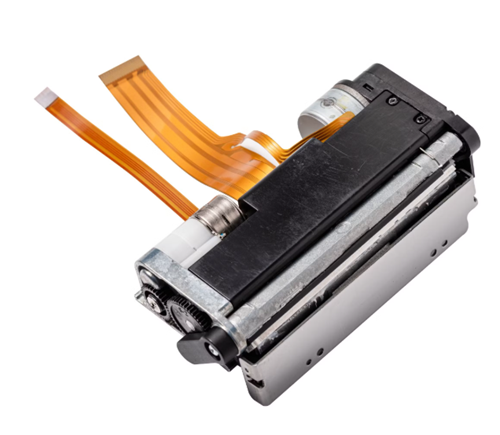
This fixed-head architecture is the reason dot line thermal printers have become the dominant printing technology in POS systems, medical instruments, kiosks, and industrial data logging devices.
What Is a Dot Line Thermal Printer?
A dot line thermal printer is a printer that generates images using a stationary thermal print head spanning the entire width of the paper.
The print head consists of a single horizontal row of microscopic heating elements (dots). As thermal paper moves forward, the printer selectively activates these elements to print a complete line of pixels at once. Text, graphics, barcodes, and waveforms are formed line by line as the paper advances.
This design fundamentally differs from serial printers, where a small print head moves laterally across the paper to draw characters or graphics.
Important Clarification
“Dot line” describes the print head architecture, not the printing material.
• Dot line printers are commonly used with direct thermal paper.
• The same dot line architecture can also be used in thermal transfer systems when paired with ribbon mechanisms.
How Dot Line Thermal Printing Works
Dot line thermal printing relies on precise coordination between electronic control, thermal activation, and mechanical paper movement.
1.Data Processing
The printer’s controller receives print data and converts it into a bitmap image representing each line of dots.
2.Thermal Activation
Electrical current is applied to selected resistive elements on the ceramic print head.
3.Chemical Reaction
Heat triggers a color change in the thermochromic coating of the thermal paper, producing black pixels.
4.Paper Advancement
A stepper motor advances the paper by one line immediately after the heating cycle.
5.Continuous Rendering
This sequence repeats hundreds of times per second, forming a continuous image.
Because image formation is not limited by lateral head movement, performance is governed primarily by thermal dissipation efficiency and paper feed precision, rather than mechanical carriage speed.
Dot Line vs. Serial Thermal Printers
Understanding the difference between dot line and serial printing is essential when selecting a printer for embedded or commercial systems.
Dot Line Thermal Printers
• Fixed, full-width print head
• Entire line printed simultaneously
• Very high print speed
• Low noise and vibration
• Fewer moving parts
Serial Thermal or Impact Printers
• Moving print head or carriage
• Characters printed sequentially
• Slower output
• Higher mechanical wear
• Noticeable operational noise
This architectural difference explains why serial printers have largely disappeared from modern POS, medical, and kiosk systems.
Key Advantages of Dot Line Thermal Printing
Dot line thermal printers offer several advantages that make them ideal for professional and industrial environments.
High-Speed Output
Printing a full line at once allows dot line printers to reach speeds of 200–300 mm/s, critical in high-throughput applications such as retail checkout and ticket issuance.
Low Operating Noise
With no lateral head movement, the only audible sound is the paper feed motor. This makes dot line printers suitable for hospitals, laboratories, and customer-facing kiosks.
High Reliability
The stationary print head minimizes mechanical wear, resulting in longer Mean Time Between Failures (MTBF) and lower maintenance requirements.
Superior Graphics and Barcode Quality
Dot line printing produces precise bitmaps, enabling sharp QR codes, barcodes, logos, and medical waveforms with consistent scan reliability.
Primary Industry Applications
Dot line thermal printers form the core printing mechanism in many everyday systems.
Point of Sale (POS) and Retail
Most 80 mm receipt printers used in supermarkets, restaurants, and retail chains rely on dot line thermal technology to prevent checkout delays during peak traffic.
Medical Instrumentation
ECG machines, patient monitors, and diagnostic analyzers use dot line printers to produce accurate, continuous waveforms without vibration-induced distortion.
Kiosks and Self-Service Systems
ATMs, parking ticket machines, and airport check-in kiosks depend on dot line printers for consistent performance, low paper jams, and minimal service intervention.
Logistics and Labeling
Desktop and portable label printers use dot line technology to produce scannable shipping labels, supporting variable barcode density and fast batch printing.
Technical Selection Criteria
When selecting a dot line thermal printer or print mechanism, three core parameters define real-world performance.
Resolution (DPI)
• 203 DPI (8 dots/mm): Standard for receipts, tickets, and shipping labels
• 300 DPI or higher: Required for medical charts, small fonts, and dense barcodes
Print Width
Common widths include:
• 58 mm (2-inch): Portable and handheld devices
• 80 mm (3-inch): POS receipts and kiosks
• 112 mm (4-inch): Logs, charts, and wide-format outputs
Platen Roller Quality
The platen roller applies pressure between the paper and print head. Uneven pressure leads to faded areas or incomplete dot activation, regardless of DPI or speed claims.
In practice, advertised print speed is meaningless without proper platen pressure and thermal density calibration.
Conclusion
Dot line thermal printers are the backbone of modern transactional and data-logging printing. By eliminating the mechanical complexity of a moving print head, they deliver faster output, quieter operation, and superior durability compared to legacy printing technologies.
For system designers and manufacturers, the key to successful integration lies in balancing resolution requirements, print width, and interface compatibility, while ensuring consistent mechanical pressure and thermal control. When properly selected, a dot line thermal printer provides years of reliable, maintenance-efficient operation across demanding commercial and industrial environments.