Compliance and Certification Guide for Thermal Printer Mechanisms
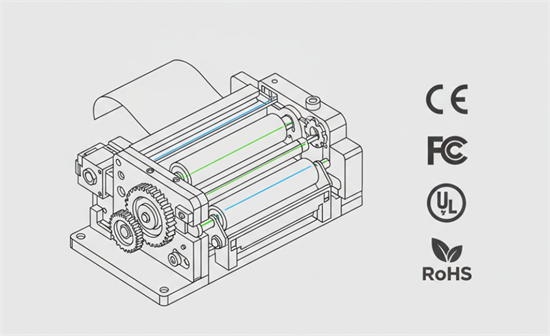
When developing an embedded device that includes a thermal printer mechanism, compliance and certification are not optional—they are the passport to global markets.
From CE and FCC to UL, RoHS, and REACH, each standard ensures the product is safe, environmentally sound, and legally approved for distribution. This guide explains the most relevant certifications and what engineers and procurement teams need to prepare before production.
1. Why Compliance Is Critical for Thermal Printer Mechanisms
A thermal printer mechanism may seem like a small component, but once embedded in a kiosk, medical analyzer, or payment terminal, it becomes part of a regulated electronic system.
Compliance proves that the mechanism:
• Meets electrical safety and EMC (electromagnetic compatibility) limits
• Uses non-hazardous materials under environmental directives
• Can be sold legally in regions such as the EU, US, or Japan
Using certified mechanisms reduces testing time for your final product and prevents costly redesigns or customs delays.
2. CE Mark (Europe)
The CE mark confirms that a product meets European Union safety and EMC directives.
For printer mechanisms, the most relevant standards are:
• EN 55032 / EN 55035 – EMC emission and immunity
• EN 62368-1 – Safety for audio, video, and IT equipment
Manufacturers or OEM integrators must provide:
• A Declaration of Conformity (DoC) signed by the responsible party
• Test reports from an accredited lab
• Technical documentation (schematics, layout, material lists)
If your device includes other sub-modules, use CE-certified mechanisms to simplify your system-level testing.
3. FCC Certification (United States)
In the US, the Federal Communications Commission (FCC) regulates electromagnetic interference.
Thermal printer mechanisms fall under Part 15, Class A or B (industrial or residential use).
What to know:
• Class B is stricter and required for devices used near consumers.
• Shielding, proper grounding, and cable ferrites help meet limits.
• FCC requires identification labeling and documentation of testing.
Using a mechanism with FCC pre-approval allows you to reference its report in your system application, reducing certification time.
4. UL Certification and Safety Standards
UL (Underwriters Laboratories) focuses on electrical safety and fire resistance.
Two standards are key for printer mechanisms:
• UL 62368-1 – Electrical safety for IT and communication devices
• UL 94 – Flammability rating for plastics (V-0, V-1, HB)
Why it matters:
UL testing checks temperature rise, insulation distance, and fire behavior of plastic frames or covers.
UL 94 V-0 materials self-extinguish quickly and are preferred in kiosks or ticketing terminals installed in public areas.
Always confirm that your mechanism’s housing and PCB materials meet at least UL 94 V-1 or better.
5. Environmental Compliance: RoHS and REACH
Environmental regulations control the use of hazardous substances in electronics.
RoHS (Restriction of Hazardous Substances)
Limits lead, mercury, cadmium, hexavalent chromium, and certain flame retardants (PBB, PBDE).
Suppliers must provide a RoHS declaration and material composition list verified by lab analysis.
REACH (Registration, Evaluation, Authorization and Restriction of Chemicals)
Requires disclosure if any component contains SVHCs (Substances of Very High Concern) above 0.1%.
A REACH-compliant mechanism guarantees safer operation and smoother customs clearance in Europe.
6. Flame Rating and Safety Isolation
Thermal printers operate at high heat and may be installed in confined spaces.
Therefore, flame-retardant and insulated materials are essential.
Use UL 94 V-0 plastics for frames and covers.
Maintain minimum creepage and clearance distances on PCBs (per UL 62368-1).
Implement thermal fuses or temperature sensors near the print head.
These measures not only support certification but also extend product lifetime and reliability.
7. EMC and Pre-Compliance Tips
Failing EMC tests is the most common delay for embedded printer projects.
To improve pass rates:
Keep motor and heater power lines isolated from logic ground.
• Add ferrite beads and bypass capacitors near connectors.
• Use twisted pairs for stepper motor wiring to reduce radiated noise.
• Test early with a spectrum analyzer or pre-compliance chamber before sending to an accredited lab.
• Designing with compliance in mind can save thousands of dollars in retests.
8. Documentation Checklist for OEMs
Before shipment or audit, your compliance file should include:
• Declaration of Conformity (DoC) – signed and dated
• Lab test reports (CE, FCC, UL, RoHS, REACH)
• Material declaration sheet (MDS)
• Product datasheet and schematics
• Component certificates from suppliers
• EOL/PCN policy for traceability
• Proper documentation builds trust with clients and regulators—and shortens time to market.
9. Key Takeaways
Choose mechanisms already certified for CE, FCC, UL, and RoHS to reduce risk.
Verify flame rating, insulation, and EMC design during hardware review.
Maintain updated compliance documentation for audits and export.
Partner with reputable suppliers that offer full certification reports and transparent material data.
Regulatory compliance may seem complex, but it’s the foundation of reliable, market-ready printer designs.