How Barcode Printers Support Blood Bank Traceability
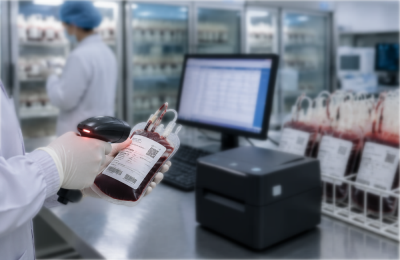
When people think about blood banks, they usually focus on donors, testing procedures, or storage conditions. What often goes unnoticed is the simple barcode label attached to every blood bag.
Yet that small label plays a much bigger role than most people realize. It connects physical blood products to digital records, helps prevent identification mistakes, and makes it possible to trace a blood unit from donation to transfusion.
Behind that process is a barcode printer.
Why Traceability Matters in Blood Banks
Blood products move through multiple stages before reaching a patient. A single unit may be collected at a donation center, tested in a laboratory, stored in a blood bank, transported to a hospital, and finally used during a transfusion.
At each step, accurate identification is critical.
If a blood unit is mislabeled, misplaced, or confused with another batch, the consequences can be serious. Blood banks also need to know exactly where products are located, which units are approaching expiration, and whether any batches need to be recalled.
In other words, traceability is not just an inventory issue. It's a patient safety issue.
What Information Is Stored in a Blood Bag Barcode?
Modern blood bag labels typically contain more than a simple ID number.
A barcode may include:
· Donor identification
· Blood type
· Collection date
· Expiration date
· Unit or batch number
· Testing status
Many organizations now use 2D barcodes, such as DataMatrix codes, because they can store more information in a compact space.
When a technician scans the label, the system can instantly retrieve the blood unit's history and current status. No manual searching. No guessing. Just a quick scan and the information is there.
Where Barcode Printers Fit Into the Process
It's easy to think of barcode printers as just another piece of equipment sitting on a desk. In reality, they sit at the very beginning of the traceability chain.
Every tracking system depends on readable labels. If a barcode is blurry, damaged, or poorly printed, the entire workflow can slow down.
A reliable barcode printer helps create:
· Clear, scannable barcodes
· Consistent label quality
· Accurate identification records
· Faster data capture throughout the workflow
You could say the barcode printer turns digital information into something the real world can actually use.
Without that printed label, there is nothing to scan.
How Barcode Labels Improve Safety and Efficiency
One of the biggest advantages of barcode-based tracking is that it reduces manual handling.
Instead of typing long identification numbers into a system, staff can scan labels in seconds. That may not sound like much, but in a busy blood bank handling hundreds or thousands of units, those seconds add up quickly.
More importantly, scanning helps reduce human error.
Barcode labels support:
· Blood inventory management
· Expiration date monitoring
· First-expired-first-out workflows
· Blood unit verification before transfusion
· Faster batch recalls when necessary
If an issue is discovered with a specific batch, staff can identify affected units much more quickly than with paper records alone.
That's one reason traceability systems have become standard practice across modern healthcare facilities.
Why Print Quality Matters More Than Many People Think
A barcode is only useful if it can be scanned.
Blood bags often face conditions that ordinary labels do not. They may be stored in refrigerated environments, exposed to moisture, handled repeatedly, or transported between facilities.
A label that looks fine on the day it is printed may become difficult to scan weeks later if the printing quality or label material is not suitable.
This is why many blood banks pay close attention to:
· Print resolution
· Barcode contrast
· Label durability
· Resistance to moisture and abrasion
The goal is simple: make sure the barcode remains readable throughout the entire lifecycle of the blood product.
Looking Ahead
As healthcare systems become more connected, blood bank traceability will continue to evolve. Real-time inventory visibility, digital health records, and smarter supply chains are already becoming common.
But even as software grows more sophisticated, the basics still matter.
Every digital record eventually needs a physical identifier that people and machines can recognize. That's where barcode printing remains essential.
The technology itself may seem simple, but its impact is significant. A well-printed barcode helps blood banks work more efficiently, respond more quickly to recalls, and most importantly, maintain a safer path from donor to patient.
Recent posts
Previous article