The Chemistry Behind Thermal Paper Printing: How Heat Creates Images Without Ink
Thermal printers are often described as "ink-free" printing solutions, but that description only tells half the story.
A thermal printer does not spray ink or transfer toner onto paper. Instead, it uses controlled heat to trigger a chemical reaction inside specially coated thermal paper. The image appears because the paper itself contains the materials needed to create visible marks.
This simple process is the reason thermal printers are widely used in receipt printing, barcode labels, POS systems, and portable printing devices.
Understanding the chemistry behind thermal paper helps explain why print quality, durability, and paper selection matter so much.
How Does Thermal Paper Create an Image Without Ink?
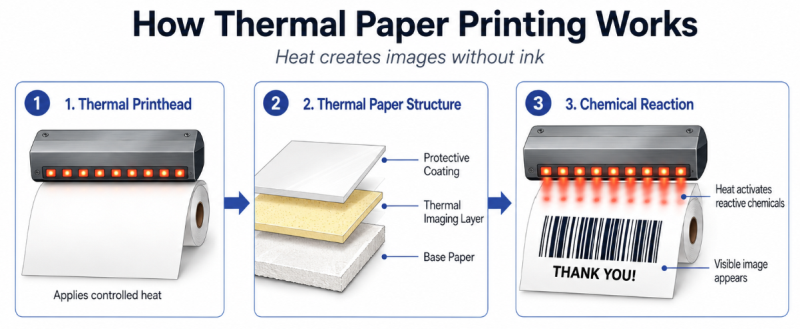
Direct thermal printing relies on heat-sensitive paper with a special coating layer.
Unlike ordinary paper, thermal paper contains several functional layers, including:
· a base paper layer for physical support
· a thermal imaging layer containing reactive chemicals
· a protective coating that improves durability
When a thermal printhead applies heat to the surface, the chemicals inside the thermal layer react and create a visible image.
The printer is not adding color to the paper. It is activating a chemical system that already exists within the coating.
What Chemicals Are Used in Thermal Paper?
The image-forming process mainly depends on three components:
Leuco Dye
Leuco dyes are color-forming chemicals that can exist in two states:
· a colorless state
· a colored state
When activated under the right conditions, the molecular structure changes and the dye becomes visible.
Color Developer
The developer reacts with the leuco dye and helps produce the final color, usually black.
This reaction is highly sensitive to temperature, which allows the thermal printhead to control where images appear.
Sensitizer
The sensitizer helps control the temperature at which the reaction occurs. It allows the thermal layer to respond within a specific heat range, improving print accuracy.
Together, these materials create a controlled chemical reaction triggered by the printer's heat.
How Does a Thermal Printhead Control the Chemical Reaction?
The thermal printhead contains many tiny heating elements arranged in a line.
During printing, the printer does not heat the entire paper surface. Instead, it selectively activates individual dots.
The process works like this:
Digital image data
↓
Printhead receives instructions
↓
Heating elements activate specific areas
↓
Thermal coating reacts
↓
Visible image appears
The amount of heat applied affects the final result.
Too little heat may create a light or incomplete image.
Too much heat can reduce image sharpness or damage the paper coating.
This is why thermal printer mechanisms need precise temperature control. The printhead, paper chemistry, and printer settings must work together.
Why Does Thermal Paper Fade Over Time?
One common misunderstanding is that thermal paper "loses ink." It does not.
The issue is that the chemical reaction inside the paper can continue changing after printing.
Several factors can accelerate fading:
· high temperatures
· direct sunlight or UV exposure
· chemical contact
· poor storage conditions
For example, a receipt left inside a hot vehicle may gradually become darker or lose readability because heat continues affecting the thermal coating.
This is also why choosing the right thermal paper matters for applications requiring longer storage, such as medical records, industrial labels, or archived documents.
How Does Thermal Paper Affect Barcode Printing Quality?
For barcode applications, thermal paper performance directly affects scanning reliability.
A barcode scanner depends on clear contrast between printed areas and blank areas. If the thermal coating reacts unevenly, the result may include:
· weak black density
· unclear barcode edges
· inconsistent scanning performance
This is especially important for barcode printers used in retail, logistics, and manufacturing environments where labels need to be scanned quickly and repeatedly.
Good thermal printing performance depends on three factors working together:
· stable thermal paper chemistry
· accurate thermal printhead control
· properly configured printer settings
The printer alone does not determine print quality.
What Is the Difference Between Thermal Paper Chemistry and Thermal Transfer Printing?
It is important to distinguish direct thermal printing from thermal transfer printing.
Direct thermal printing:
· uses chemically coated paper
· requires no ribbon
· creates images through heat activation
Thermal transfer printing:
· uses a ribbon containing ink or resin
· transfers material onto the label surface through heat
· produces more durable labels for demanding environments
Because of this difference, direct thermal printing is commonly used for receipts and short-term labels, while thermal transfer printing is often preferred for long-lasting barcode labels and industrial identification.
Final Thoughts
The chemistry behind thermal paper printing is what makes ink-free printing possible.
A thermal printer does not simply "burn" an image onto paper. It uses precise heat control to activate carefully designed chemical layers inside the paper coating.
This combination of material science and printer technology explains why thermal printing remains widely used across POS, logistics, healthcare, and labeling applications.
Behind every simple receipt or barcode label is a small but carefully controlled chemical process.