Choosing the Best Label Stock for Warehouse Barcode Printers: A Practical Material Guide
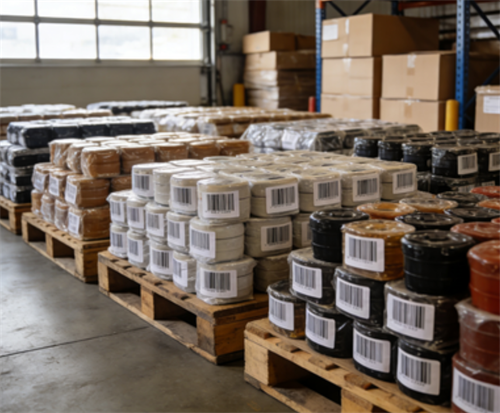
In high-throughput logistics, a single unreadable or peeling barcode can slow down receiving, picking, sorting, or shipment verification. Research commissioned by GS1 US and conducted by VDC Research found that organizations relying primarily on 1D barcode workflows report a 7% first-pass scan failure rate. That failure rate can lead to rescanning labor, relabeling, shipment errors, and avoidable workflow interruptions.
When scanning errors increase, warehouse teams often blame the printer first. In many cases, however, the issue starts with the label stock: the facestock, adhesive, ribbon match, or surface finish may not fit the warehouse environment. Choosing the best label stock for warehouse barcode printers requires looking beyond basic paper labels. This warehouse barcode label material guide explains how to match print technology, label material, adhesive, and scanning conditions to keep operations moving.
Direct Thermal vs. Thermal Transfer: Choosing Your Warehouse Label Printing Method
Before selecting a label material, match your printing method to the lifespan and handling conditions of the item being labeled. The choice between direct thermal and thermal transfer warehouse labels affects print durability, operating cost, and long-term scan reliability.
Direct Thermal (DT)
· No ribbon required
· Uses heat-sensitive label material
· Best for short-term shipping and fast-moving freight
Thermal Transfer (TT)
· Requires a wax, wax-resin, or resin ribbon
· Transfers ribbon ink onto paper or synthetic facestock
· Best for long-term inventory, rack labels, and asset tracking
Direct Thermal Labels: Best for Fast-Moving Freight
Direct thermal printers apply heat directly to chemically treated label material. The label darkens where heat is applied, eliminating the need for ink ribbons.
· Best for: Short-term tracking, such as shipping labels, cross-docking LPNs, carton labels, and package routing.
· The trade-off: Standard direct thermal labels are more sensitive to UV light, friction, heat, and long storage periods than thermal transfer labels. If they are left in a hot trailer, exposed to direct sunlight, or handled repeatedly, barcode contrast may degrade and scan reliability may fall.
Thermal Transfer Labels: Built for Long-Term Use
Thermal transfer printing melts a wax, wax-resin, or resin ribbon onto the label facestock, creating a durable, high-contrast barcode image.
· Best for: Location racks, long-term inventory, bin labeling, reusable containers, and asset tracking.
· The trade-off: Thermal transfer printing requires ribbons and proper ribbon-material matching. However, when the right ribbon and facestock are paired, it provides stronger resistance to fading, scratching, moisture, and chemical exposure than standard direct thermal labels.
Printer Compatibility Comes Before Label Selection
Even the right label material can perform poorly if it does not match the printer. Before ordering warehouse barcode labels, confirm the printer's supported media width, roll outer diameter, core size, sensing method, print resolution, and media type.
For warehouses using HPRT barcode printers, label stock should be selected together with the print method, ribbon type, media size, and operating environment. This helps ensure stable feeding, clear barcode output, and consistent scanning performance across receiving, picking, packing, and inventory workflows.
Selecting the Right Facestock for Warehouse Barcode Labels
The facestock is the printable surface that carries the barcode. It must handle physical abrasion, moisture, bending, surface texture, and rough handling during warehouse operations.
Premium Paper Stocks: Cost-Effective Indoor Tracking
Coated paper stocks are the most economical option for many warehouse labeling tasks. When paired with thermal transfer wax ribbons, coated paper can provide enough scratch resistance for indoor cardboard boxes, pallet labels, and short-term inventory tracking in climate-controlled environments.
· Best for: Shipping cartons, pallet tracking, temporary inventory labels, and general indoor warehouse use.
· Not ideal for: Wet areas, outdoor storage, chemical exposure, reusable totes, or long-term rack labels.
Synthetic Label Materials: When to Use PP or PET
When paper is not durable enough, synthetic facestocks offer better resistance to moisture, tearing, abrasion, and temperature variation. The choice between polypropylene and polyester barcode labels depends on durability, flexibility, and surface conditions.
· Polypropylene (PP): PP is a flexible, moisture-resistant thermoplastic that can conform slightly to curved or uneven surfaces. It works well on plastic totes, storage bins, shrink-wrapped pallets, and reusable containers.
· Polyester (PET): PET provides excellent dimensional stability, tear resistance, and temperature tolerance. It is often used for long-term rack labels, asset labels, equipment labels, and industrial environments where labels must remain readable for years.
Matching Ribbons to Label Materials
For thermal transfer barcode printing, the ribbon is just as important as the label material. A mismatched ribbon may produce poor barcode contrast, weak scratch resistance, or premature fading.
· Paper labels + wax ribbon: A cost-effective choice for cartons, pallets, and short-term indoor inventory.
· Polypropylene labels + wax-resin ribbon: A balanced option for plastic containers, handling resistance, and moderate durability.
· Polyester labels + resin ribbon: A durable choice for rack labels, asset tracking, chemical exposure, and long-term warehouse identification.
Why Standard Labels Peel Off Powder-Coated Warehouse Racks
Selecting the right adhesive is just as important as choosing the right facestock. Standard labels peeling off warehouse racking is a common issue, especially in facilities using powder-coated steel racks.
The Challenge of Low Surface Energy Steel Racks
Many modern warehouse racks use powder-coated finishes. These surfaces often have low surface energy, which makes it difficult for standard adhesives to spread, wet out, and form a strong bond. A helpful comparison is a non-stick pan: the surface resists bonding, so ordinary adhesives may curl, lift, or fall off over time.
Using Low Surface Energy Adhesives
For powder-coated racks, specify labels with low surface energy adhesives. These specialized adhesives are designed to flow into microscopic surface textures and create a stronger bond on difficult materials such as powder-coated metal, certain plastics, and textured industrial surfaces.
· Best for: Permanent rack labels, shelf labels, bin locations, pallet rack identification, and long-term warehouse signage.
Preventing Scanner Reflection with Matte Barcode Labels
Even a secure label is useless if fixed scanners or handheld scanners cannot read it reliably. Highly glossy labels can create glare, overexposure, or poor barcode contrast in certain scanning environments.
Glare Problems on Glossy Synthetic Labels
Automated sorting lines, fixed-position scanner arrays, and drone-based scanning systems rely on rapid optical capture. When a scanner's light source hits a glossy polyester label at the wrong angle, the reflection can wash out the barcode image and reduce first-pass scan performance.
Why Matte Facestocks Improve Scan Reliability
To reduce glare, use matte or anti-glare barcode labels in high-speed scanning environments. Matte synthetic facestocks scatter reflected light more evenly, helping scanners capture a cleaner, higher-contrast barcode image.
· Best for: Automated sorting lines, rack scanning, overhead scanning, drone scanning, and facilities with strong LED lighting.
Freezer-Grade Barcode Labels: Solving Cold Storage Adhesion Issues
Cold chain facilities require specialized label materials and adhesives to handle low temperatures, condensation, frost, and thermal cycling. One common mistake is confusing application temperature with service temperature.
Application Temperature vs. Service Temperature
· Application temperature refers to the ambient temperature when the label is physically applied to a box, pallet, tote, or package.
· Service temperature refers to the temperature range the label must survive after it has bonded to the surface.
A label may survive freezing temperatures after bonding, but still fail if applied inside a cold room below its minimum application temperature.
Choosing the Right Freezer-Grade Adhesive
Standard general-purpose adhesives often fail when applied in cold rooms because the adhesive can harden before it properly wets out on cardboard, plastic, or shrink wrap. For cold storage, choose freezer-grade barcode labels formulated for the required application temperature and service temperature.
Depending on the surface and temperature range, the adhesive may be a rubber-based hot melt for strong cold initial tack or a specialized acrylic adhesive for longer-term durability. The right choice depends on whether the label is applied before freezing, inside a cold room, or directly onto lightly frosted packaging.
· Best for: Frozen food warehouses, cold chain logistics, pharmaceutical storage, refrigerated transport, and freezer inventory labels.
Warehouse Barcode Label Material Guide: Quick Selection Matrix
Because manufacturer testing protocols vary, use these typical industry ranges as practical guidelines rather than absolute rules.
Facestock Material | Print Method | Ribbon Compatibility | Adhesive Type | Primary Application |
Direct Thermal Paper | Direct Thermal | None | General-purpose acrylic | Shipping labels, shipping cartons, short-term routing |
Thermal Transfer Paper | Thermal Transfer | Wax ribbon | General-purpose acrylic | Short-term indoor inventory, pallet labels |
Polypropylene (PP) | Thermal Transfer | Wax-resin ribbon | High-tack acrylic | Plastic totes, storage bins, shrink-wrapped pallets |
Matte Polyester (PET) | Thermal Transfer | Resin ribbon | Modified LSE acrylic | Permanent rack labels, industrial assets, shelf labels |
Freezer-Grade PET/PP | Thermal Transfer | Resin or wax-resin ribbon | Freezer-grade hot melt or acrylic adhesive | Cold storage, freezer inventory, refrigerated logistics |
Green Logistics: Considering Sustainable Linerless Barcode Labels
ESG initiatives are encouraging more warehouses to evaluate sustainable linerless thermal label systems. These labels do not use a traditional silicone backing liner, which can reduce liner waste and improve roll efficiency.
Depending on label size, roll configuration, and printer design, linerless rolls may fit significantly more usable label material per roll than traditional linered labels. This can reduce roll changes and help lower waste in high-volume labeling environments.
However, linerless labels require compatible printers with suitable non-stick rollers, cutters, and media paths. Using linerless media on an incompatible printer can cause adhesive buildup, feeding issues, or cutter jams.
Summary
A warehouse barcode label is a critical link in supply chain data flow. Poor label stock can cause scan failures, relabeling work, lost inventory visibility, and delays across receiving, picking, packing, and shipping.
To choose the best label stock for warehouse barcode printers, start with the label's working environment. Match the print method to the label lifespan, pair the facestock with the right ribbon, use LSE adhesives for powder-coated racks, choose matte surfaces for scanner-heavy environments, and specify freezer-grade adhesives for cold storage. With the right label stock, warehouses can improve first-pass scan reliability, reduce unnecessary labor, and keep fulfillment lines moving.