Thermal Printer Mechanism Market: 2026 Outlook, Drivers & What to Watch
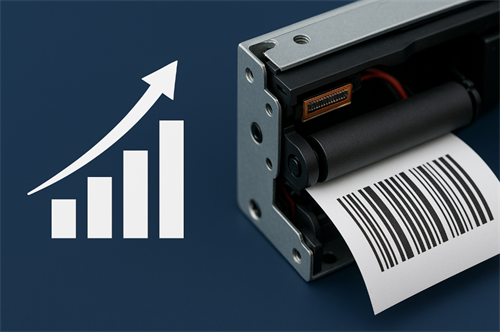
The market for internal assemblies in thermal printers—those modules that drive printing operations in labels, tickets and receipts—may appear niche. But when you zoom out, you see a strong base of demand beneath it. Understanding that broader context gives you a clearer read on where mechanisms are headed.
Market Size & Growth Outlook
The global thermal printing market (printers + supplies) was estimated at USD 43.61 billion in 2025, and is projected to reach USD 53.85 billion by 2030, representing a CAGR of about 4.3%.
Another forecast expects the market to reach USD 66.4 billion by 2030, at a CAGR of about 5.3%.
Putting that together: while the market isn’t explosive, it is reliably expanding. For mechanism suppliers, that means opportunity—especially in upgrade- and performance-driven segments.
What’s Driving Demand?
• E-commerce and logistics growth: More parcels, more labels, more demand for durable and fast label printers in shipping and warehousing. That scenario supports the module side.
• Retail labelling and 2D barcode transition: Global industry initiative GS1 is targeting migration to 2D barcodes by 2027 (“Sunrise 2027”), which means labels may require higher data density and more precise print function.
• Industrial & automated workflows: Manufacturing, cold-chain, smart warehouses—they rely on printing inline, often requiring compact, fast modules with long head/cutter life.
• Supplies + mechanism synergy: As printers work harder, modules and print heads must endure more cycles; supplies (ribbons, media) evolve, but modules must keep pace.
Technology & Product Trends Worth Tracking
• Speed/Throughput: Modules rated for ~200 mm/s are increasingly the baseline; some manufacturers are advertising ~300–350 mm/s designs to match high-volume workflows.
• Compact, Integrated Modules: Many printers designed for kiosks, self-service, mobile receipt or tag printing push mechanism makers to shrink size, integrate cutter/roller and simplify installation.
• Durability & Lifecycle: As downtime costs grow, buyers prefer modules rated for higher head life, extended cutter life and minimal media jams—particularly in logistics or retail high-use cases.
• Regional Supply & Specialisation: Asia-Pacific remains a major volume and manufacturing base; premium modules often involve Japanese or high-end specialist firms. Given the size of the base market, suppliers who offer higher specification modules may command stronger margin.
What to Watch – Risks & Considerations
• Moderate Growth vs High Expectations: A ~4–5% CAGR is respectable, but not dramatic. Mechanism makers must lean on differentiation (speed, durability, integration) rather than rely on volume alone.
• Digital Substitution: Some receipt-printing volumes face substitution (e.g., mobile/digital receipts) or decline; the mechanism market must pivot to label/ticket/industrial workflows rather than rely purely on paper receipts.
• Inventory & Pricing Pressure: With moderate volume growth, competition may squeeze margins—especially for commodity modules. Suppliers need to emphasise value-adds.
• Standards & Adoption Timing: Though the 2D transition is underway, actual implementation pace may vary regionally—delays could affect the module upgrade cycle.
Strategic Implications for 2026-2027
Before looking ahead, it’s worth translating these market signals into practical actions. The following points outline what manufacturers and suppliers should prioritise through 2026 and 2027.
• Focus on modules for upgrade workflows: New installations are good—but much of the opportunity lies in replacement/upgrade of older, slower modules.
• Prioritise high-speed, compact modules: Modules for mobile printing, kiosks and high-density labels should be central in the roadmap.
• Educate buyers on Total Cost of Ownership (TCO): Show how higher-life modules reduce downtime, maintenance and replacements—especially in logistics/retail settings.
• Monitor end-use shifts: If retail labelling migrates substantially to digital‐only, mechanism demand may pivot toward other segments (industrial, healthcare, logistics).
• Stay regionally aware: Asia-Pacific remains a growth engine; mature markets (North America, Europe) still offer niches for premium modules.
The path ahead for thermal printer mechanisms is steady, not flashy. Demand will favor makers who focus on speed, size, and endurance. As printing moves toward 2D codes and faster workflows, the real question is simple—who will keep pace?